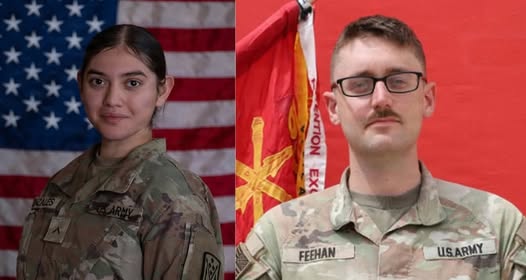
FORT BRAGG, NC – The U.S. Department of Defense on Monday released the identities of two American service members killed in Jordan during a coordinated Iranian attack involving ballistic missiles and explosive-laden drones, bringing the solemn toll of American military deaths tied to the escalating conflict with Tehran to 17. The fallen soldiers are Pvt. Isabella Gonzales, 19, a native of Carrollton, Texas, and 1st Lt. Tyler James Feehan, 25, who hailed from Ewa Beach, Hawaii. Both were assigned to air defense artillery units—the very soldiers whose job it is to detect, track, and neutralize incoming aerial threats—yet they fell in the line of duty while defending against an onslaught that overwhelmed defensive systems at their forward operating base in Jordan.
According to a statement from the Pentagon, the two service members were killed in Jordan while supporting Operation Inherent Resolve, the U.S.-led coalition mission to defeat ISIS and stabilize the region. However, military officials have confirmed that the attack that claimed their lives was not ISIS-related but rather part of a direct Iranian military escalation. The attack, which occurred on the night of July 18, 2026, involved a volley of short-range ballistic missiles and several Shahed-type drones—the same loitering munitions that Iran has supplied to proxy forces throughout the Middle East. The base, which has not been named for security reasons, was operating at a heightened threat level, but the sheer volume and speed of the incoming ordnance managed to penetrate layered defensive systems.
Pvt. Gonzales was assigned to the 1st Battalion, 57th Air Defense Artillery Regiment, part of the 52nd Air Defense Artillery Brigade, under the 10th Army Air and Missile Defense Command, which is headquartered in Ansbach, Germany. She had only recently arrived in the theater of operations, having completed basic training and advanced individual training at Fort Sill, Oklahoma, in late 2025. Friends and family describe her as a young woman who enlisted with a clear sense of purpose—she wanted to protect her country and, more personally, she wanted to follow in the footsteps of her older brother, who served as a Marine in Afghanistan. She was known for her bubbly personality, her love of country music, and her unwavering commitment to her fellow soldiers. “She was a warrior, but she was also a girl who loved to laugh and dance,” her mother, Maria Gonzales, told The Dallas Morning News in a tearful phone interview. “She was so proud to wear that uniform. She used to say, ‘Mom, I’m doing something that matters.’ And now she’s gone.”
1st Lt. Feehan was assigned to the 2nd Battalion, 55th Air Defense Artillery Regiment, under the 32nd Army Air and Missile Defense Command at Fort Bragg, North Carolina. A graduate of the United States Military Academy at West Point—class of 2023—Feehan was an officer who had earned the respect of his peers and his superiors. He had deployed to the Middle East just two months prior, leading a section of Patriot missile batteries that were tasked with protecting coalition assets from aerial threats. His father, retired Army Colonel James Feehan, described his son as “a natural leader who chose service over comfort.” “He could have gone to any private sector job,” the elder Feehan said. “But he believed in the mission. He believed in defending the vulnerable. And he gave his life doing exactly that.”
The Attack: A Test of Air Defense Capabilities Under Real Fire
The attack on the Jordanian base—which military analysts are calling one of the most sophisticated and sustained Iranian strikes since the 2019 attack on Saudi oil facilities—was designed to test the limits of American air defense systems. According to initial reports from U.S. Central Command (CENTCOM), the Iranians launched a coordinated salvo of at least 12 ballistic missiles and 18 drones from launch sites in western Iran. The projectiles flew over Iraqi airspace at low altitudes to evade radar, before descending on the base in Jordan with devastating precision.
The base’s defensive systems—which included both the Patriot PAC-3 and the newer Iron Dome system, which the U.S. has deployed to protect forward positions—engaged the incoming threats successfully for the first 15 minutes of the attack. However, the sheer volume of targets overwhelmed the interceptors, and at least two missiles and three drones penetrated the defensive shield. One of the ballistic missiles struck a hardened bunker where the air defense command center was housed, killing Lt. Feehan instantly and injuring three other soldiers. A second missile struck a maintenance shed near the perimeter, and a drone—carrying a 50-pound high-explosive warhead—detonated directly in the open area where Pvt. Gonzales and her crew were manning a radar system. Gonzales was killed instantly; two other soldiers in her crew were critically wounded and are now receiving treatment at a military hospital in Germany.
“The speed of the attack was breathtaking,” said a CENTCOM official who spoke on condition of anonymity. “We have seen Iranian drones before. We have seen their ballistic missiles. But we have not seen them used in combination at this scale and with this level of coordination. This was not a symbolic strike. This was a calculated attempt to inflict casualties and degrade our air defense capabilities.”
The Pentagon has confirmed that the attack was in direct retaliation for a U.S. airstrike that killed a senior Iranian Revolutionary Guard Corps (IRGC) commander in Syria four days earlier. That strike, which the U.S. called “a defensive action” against an imminent threat, reportedly killed Brigadier General Mohammad Reza Zahedi, a key figure in Iran’s extraterritorial operations. Iran’s Supreme Leader, Ayatollah Ali Khamenei, had vowed “severe retaliation,” and the Jordan attack was that promised vengeance.
A Nation Grieves: 17 Fallen and Counting
The deaths of Pvt. Gonzales and 1st Lt. Feehan bring the total number of American military deaths directly attributed to the war with Iran to 17 since the conflict began in earnest in early 2026. This number includes soldiers killed in a previous drone attack on a U.S. naval vessel in the Red Sea, a rocket attack on a base in Iraq, and now the Jordan strike. The toll is a sobering reminder that the conflict, which began as a series of tit-for-tat strikes, has evolved into a full-scale military confrontation with no end in sight.
The Pentagon has not released the names of the other 15 fallen service members, citing ongoing next-of-kin notifications and the sensitive nature of the operations. However, the Department of Defense has confirmed that the majority of the deaths have occurred in the past four months, as Iranian forces have escalated their use of ballistic missiles and drones against U.S. and coalition targets across the Middle East.
President Donald J. Trump, who has been briefed on the attack, issued a statement from the White House on Monday afternoon, calling the deaths “a tragic and unnecessary act of war by a rogue regime.” He vowed that the United States would “respond with overwhelming force” and that “the full weight of American military power will be brought to bear on the Iranian regime.” As of this writing, U.S. Navy destroyers in the Persian Gulf have been repositioned, and the Pentagon has announced that additional Patriot and THAAD batteries will be deployed to the region within the next 48 hours.
The Fallen: Remembering Pvt. Isabella Gonzales
Pvt. Gonzales was born and raised in Carrollton, Texas, a suburb of Dallas, in a close-knit Mexican-American family. She was the youngest of three children—the “baby girl” of the clan, as her father, Carlos Gonzales, called her. She attended Creekview High School, where she was a standout in track and field and a member of the school’s marching band. Her high school counselor, Mrs. Patricia Ortez, remembered her as “a girl who always had a smile and a kind word for everyone. She was not the loudest in the room, but she was the most genuine.”
After graduation in 2024, Gonzales took a gap year to help her parents care for her ailing grandmother. During that time, she watched news coverage of U.S. troops in the Middle East and felt a calling. She enlisted in the Army in February 2025, telling her mother, “I want to be part of something bigger than me.” She shipped to basic training at Fort Sill, Oklahoma, that summer, and she graduated as an air defense artillery specialist—a job that required intense technical training on radar systems and missile launchers.
She deployed to Germany in April 2026, and then to Jordan in June. Her last conversation with her mother was on July 15, just three days before the attack. “She told me she was proud of what she was doing,” Maria Gonzales said. “She said, ‘Mom, I’m protecting people. I’m making a difference.’ I told her I loved her and to be careful. She laughed and said, ‘Don’t worry, Mom. I’m a soldier. I’m ready.'”
Now, that laughter is silent. Her body is being repatriated to the United States, and funeral arrangements are being made at the Dallas-Fort Worth National Cemetery. She will be posthumously awarded the Purple Heart and the Army Commendation Medal.
The Fallen: Remembering 1st Lt. Tyler James Feehan
1st Lt. Feehan was a product of military lineage. His father, Colonel James Feehan, served 28 years in the Army, retiring in 2019. His grandfather served in Vietnam. Tyler grew up on bases around the world—from Hawaii to Germany to Georgia—and he never considered any career other than the military. He attended West Point, where he graduated with honors in mechanical engineering. He also played on the rugby team and was known for his ability to rally his teammates with motivational speeches.
“I remember his first day as a platoon leader at Fort Bragg,” said Captain Michael Shea, his commanding officer. “He walked in, looked at his soldiers, and said, ‘I don’t want you to follow me because I’m an officer. I want you to follow me because I’ll be right beside you.’ And he was. He was always with his men. He trained with them, ate with them, and fought with them.”
Feehan deployed to Jordan in May 2026. He wrote letters to his wife, Sarah, a nurse practitioner at a hospital in Fayetteville, and his 2-year-old daughter, Emma. His letters described the heat, the dust, and the constant alert status—but they also described his commitment. In a letter written just two weeks before his death, he wrote: “The work is hard, but it matters. I know that if I do my job, maybe one family somewhere in the world will get to see their daughter or son come home. That is enough for me.”
Now, he will not come home. His wife, Sarah, released a brief statement through the Army: “Tyler was my best friend, my partner, and the father of our beautiful daughter. He lived his life with courage, honor, and love. My heart is broken, but I am so proud of him. He died doing what he believed in. He died defending his country and his family.”
The Geopolitical Context: A War Escalating by the Day
The attack in Jordan is the latest—and bloodiest—chapter in an escalating conflict that has drawn the United States into direct military confrontation with Iran. The roots of this conflict can be traced back to the Trump administration’s “maximum pressure” campaign against Tehran, which included sanctions, diplomatic isolation, and the assassination of IRGC commander Qasem Soleimani in 2020. However, the current phase of the war began in earnest in early 2026, when Iran launched a series of drone attacks on U.S. bases in Iraq and Syria, and the U.S. responded with airstrikes on Iranian nuclear facilities.
In the weeks leading up to the Jordan attack, Iran had been threatening a “definitive response” to the killing of Brigadier General Zahedi in Syria. That killing, which the U.S. has not officially confirmed, was widely attributed to an Israeli airstrike, but Iran blamed the U.S. for providing intelligence and support. The Jordan attack, therefore, was a direct Iranian reprisal against American forces—a signal that Tehran is unwilling to back down.
Military experts warn that this attack could trigger a broader conflict. “The U.S. is now in a position where it must respond,” said Dr. Michael O’Brien, a professor of strategic studies at the Naval War College. “If the U.S. does not retaliate forcefully, it signals weakness to Iran and its proxies. But if the U.S. retaliates too aggressively, it risks a full-scale war. This is a delicate dance, and the stakes are extremely high.”
The Pentagon has confirmed that it is planning a “measured and proportionate” response, but the definition of “proportionate” remains unclear. Options on the table include airstrikes on IRGC bases in Iran, cyberattacks on Iranian infrastructure, or even a targeted assassination of senior Iranian military leaders. Whatever the response, it is almost certain to escalate the conflict further.
A Nation Mourns, a War Continues
The deaths of Pvt. Gonzales and 1st Lt. Feehan have sent shockwaves through the military community and beyond. At Fort Bragg, the flag was lowered to half-staff on Monday. At Fort Sill, where Gonzales trained, a memorial ceremony was held in her honor. And at West Point, the chapel bell tolled 25 times for Feehan—one for each year of his life.
Meanwhile, the Department of Defense continues to release information as more families are notified. The total of 17 American deaths is a number that will only grow as the conflict continues. And as the nation mourns, the question remains: How far will the U.S. go to retaliate? And how many more young soldiers will be sent to the Middle East—and never return?
The answers may come in the coming days. But for now, two families are burying their children. Two flags are draped over coffins. And two young service members, who answered the call of duty, have made the ultimate sacrifice.
Conclusion
Pvt. Isabella Gonzales and 1st Lt. Tyler James Feehan are gone. One was a 19-year-old girl from Texas who loved to dance and laugh. The other was a 25-year-old officer from Hawaii who loved his wife and daughter and his country. They were both air defenders—soldiers whose job was to protect others from the sky. But on that night in Jordan, the sky brought death.
Their sacrifice will not be forgotten. The U.S. military will honor them with medals and memorials. Their families will honor them with love and tears. And the nation—divided as it is—will stand united in grieving them.
As the war with Iran grinds on, the tally of the fallen will rise. But for now, we remember these two. We remember their courage. We remember their service. And we remember their names.
Pvt. Isabella Gonzales, 19, Carrollton, Texas.
1st Lt. Tyler James Feehan, 25, Ewa Beach, Hawaii.
Rest in peace, soldiers. The nation is grateful, and the nation is heartbroken.

Leave a Reply