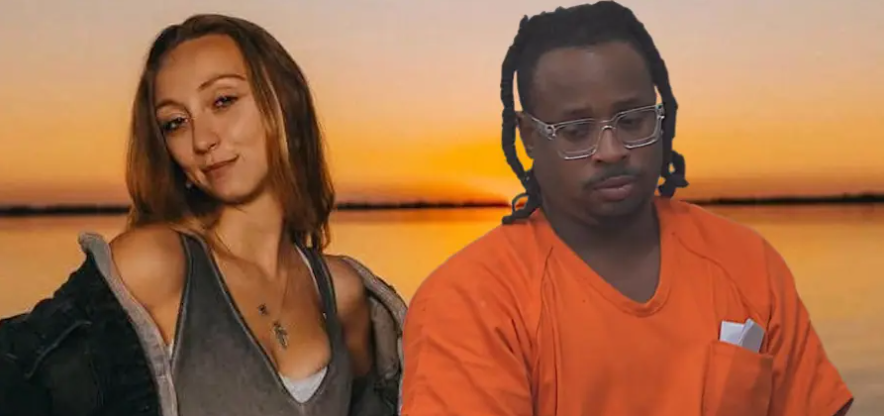
INDIANAPOLIS, IN – A downtown intersection that should have been a quiet early-morning passage turned into a scene of carnage on July 11, 2026, when a speeding Dodge Challenger plowed into a young mother riding a scooter through a marked crosswalk. The driver, Caprice Glass, 40, of Indianapolis, fled the scene without stopping, leaving Brianna Evans, 26, to die in the street from massive blunt-force injuries. Now, prosecutors confirm that Glass has signaled his intention to plead guilty to the charge of leaving the scene of an accident resulting in death or catastrophic injury, a Level 3 felony under Indiana law that carries a potential sentence of 3 to 16 years in prison.
The crash occurred at approximately 3:15 a.m. on Saturday, July 11, at the intersection of East Maryland Street and South Pennsylvania Street in the heart of Indianapolis’ downtown entertainment district. Evans, a mother, daughter, and sister described by her family as a “vibrant soul with a contagious laugh,” was operating a motorized scooter—one of the many rentable e-scooters that dot the city’s sidewalks. She was navigating the intersection legally, within a marked crosswalk, when Glass’s silver or gray Dodge Challenger, traveling eastbound on Maryland Street, struck her with catastrophic force.
According to the crash reconstruction report filed with the Marion County Superior Court, the vehicle was traveling at an estimated 43 miles per hour immediately before impact—nearly double the posted 25 mph speed limit in that downtown corridor. The reconstruction also determined that Glass proceeded through a red traffic signal at the intersection of Maryland and Delaware streets—one block east of the crash—after the collision, continuing his flight without so much as a pause. The Challenger left behind a trail of debris: shattered headlight fragments, pieces of the front bumper, and a grille section bearing the unmistakable Dodge emblem. Witnesses who had been in the area reported seeing a gray or silver Dodge Challenger driving “recklessly and at high speed” in the minutes leading up to the crash.
The Marion County Coroner’s Office later determined that Evans died from multiple blunt-force injuries, including fractures to her pelvis, ribs, and skull, as well as internal hemorrhaging. She was pronounced dead at the scene at 3:28 a.m. Her family, who learned of her death later that morning, described her as a devoted mother to a young daughter and a beloved sister who had just started a new job at a local medical clinic. “She was full of life,” her mother, Tanya Evans, told reporters. “She was always smiling, always helping others. And now she’s gone because someone couldn’t stop and didn’t care enough to stay.”
The Investigation: A Technological Dragnet and a Concealed Weapon
The Indianapolis Metropolitan Police Department (IMPD) launched an immediate, comprehensive investigation that relied heavily on modern forensic tools. Detectives from the Fatal Crash Investigation Unit began by canvassing the scene, collecting debris, and interviewing witnesses. They also pulled footage from the city’s extensive network of surveillance cameras, including those operated by the Real-Time Crime Center, which monitors high-traffic areas downtown.
License plate reader (LPR) technology proved instrumental. The IMPD’s LPR system, which automatically captures and logs license plates of passing vehicles, flagged a silver Dodge Challenger that had been recorded in the vicinity of the crash at the relevant time. Cross-referencing that data with city traffic cameras allowed detectives to track the vehicle’s movement before and after the collision. The video evidence showed the Challenger speeding eastbound on Maryland Street, striking Evans, and then continuing through the red light at Delaware Street without stopping. The vehicle was then seen turning south onto Pennsylvania Street and disappearing into the night.
On July 13, two days after the crash, detectives used the LPR data and witness statements to identify Caprice Glass as the registered owner of the silver Dodge Challenger in question. A driver’s license photograph matched the surveillance footage of the driver’s silhouette. With a search warrant in hand, officers descended on a residence on South Worth Avenue, on the city’s south side, where they found the Challenger hidden beneath a heavy tarp in a driveway. The vehicle exhibited significant front-end damage: a crushed hood, a missing headlight, a shattered grille, and a bent front bumper. Forensic analysts later confirmed that the debris recovered from the crash scene—including a specific part number traced to a Dodge Challenger—matched the damaged and missing portions of Glass’s vehicle. It was a forensic fingerprint, as unmistakable as a signature.
Glass was arrested on July 14 in the 4100 block of North Keystone Avenue, a location that police have not fully explained but which they described as “a non-residential area” where he was found in another vehicle. He was taken into custody without incident and charged with a preliminary Level 3 felony for leaving the scene of an accident resulting in death. During his initial court appearance on July 20, before Judge Mark A. Combs in Marion County Superior Court, Glass’s attorney, public defender Raymond K. Smith, informed the court that his client had decided to waive a preliminary hearing and would plead guilty to the charge as filed. A change-of-plea and sentencing hearing has been scheduled for September 28. Judge Combs set Glass’s cash bond at $64,000, a figure that prosecutors argued was necessary given his flight risk and prior criminal history.
A History of Recklessness: Glass’s Criminal Record Raises Questions
Court records and public databases paint a troubling portrait of Caprice Glass as a repeat traffic offender with a history of disregarding public safety. According to the Indiana Bureau of Motor Vehicles and Marion County court filings, Glass has accumulated at least three prior speeding citations in the past five years, as well as a conviction for driving without a valid license in 2019. More alarmingly, in November 2024, Glass was arrested for driving under the influence of alcohol in Marion County—a case that is still pending in court. In that incident, police reported that Glass had been stopped after swerving through traffic, and a breathalyzer test registered a blood-alcohol concentration of 0.11, above the legal limit of 0.08. That DUI case has not yet been resolved, and it is unclear how it will intersect with the current hit-and-run charge.
Perhaps most serious, however, is a felony conviction dating back to 2004. At the time, Glass—then 18 years old—was convicted of armed robbery in a case involving a convenience store hold-up. He served eight years in the Indiana Department of Correction and was released in 2012. Since then, he has maintained a relatively low profile, but his driving record suggests that his disregard for law and order has not been fully rehabilitated. “This is not a first-time offender who made a tragic mistake,” said Marion County Prosecutor Ryan Mears in a brief statement. “This is a man who has shown a pattern of reckless behavior and a complete lack of respect for human life.”
Prosecutors have not indicated whether they will seek an enhanced sentence based on Glass’s prior felony conviction or his pending DUI case. Under Indiana law, leaving the scene of an accident causing death is a Level 3 felony, punishable by 3 to 16 years in prison and a fine of up to $10,000. However, if the court considers his criminal history as an aggravating factor, the sentence could be pushed to the upper end of that range. The plea agreement, which has not yet been filed publicly, may include a recommended sentence, but Judge Combs will have the final say at the September 28 hearing.
The Victim: Brianna Evans, a Life Interrupted
To understand the depth of this tragedy, one must understand who Brianna Evans was. She was not just a statistic—a “pedestrian struck by a car.” She was a 26-year-old woman who had just turned her life around. Raised in a working-class neighborhood on the east side of Indianapolis, Evans had worked various jobs—fast food, retail, warehouse—before landing a position as a medical receptionist at a clinic on North Meridian Street. She had recently been promoted to lead receptionist, and her coworkers described her as “the first one in and the last one out,” always willing to cover shifts for colleagues with sick children.
She was also a mother. Her daughter, Kai Evans, is just 5 years old and is now being raised by her grandmother, Tanya. “Kai wakes up every morning asking for her mommy,” Tanya Evans told The Indianapolis Star in a tearful interview. “She doesn’t understand why Brianna isn’t coming home. How do you explain to a 5-year-old that her mommy was killed by a man who didn’t even stop to say he was sorry?”
Brianna Evans had been out with friends on the night of July 10, celebrating a coworker’s birthday at a downtown bar. She left the group around 2:45 a.m. to head home, using a scooter—a common mode of transport in the city’s nightlife district. She was wearing a helmet and had the scooter’s lights on, according to witnesses. She was doing everything right. And still, a 4,000-pound vehicle traveling at nearly 43 mph ended her life in a fraction of a second.
Her family has set up a GoFundMe page to cover funeral expenses and to establish a college fund for Kai. As of this writing, the page has raised over $18,000, far exceeding its $10,000 goal—a testament to the community’s outrage and compassion.
The Aftermath: Justice Delayed, But Not Denied
The plea announcement has brought a measure of closure to the Evans family, though they remain deeply scarred. “I am relieved that he is not going to put us through a trial,” Tanya Evans said. “But I am also angry. I am angry that he drove off. I am angry that he left my daughter to die alone in the street. And I am angry that this is the only justice we will ever get—a few years in prison, and then he walks free.”
The Indianapolis Metropolitan Police Department has publicly credited the swift resolution of this case to the cooperation of witnesses, the community’s tips, and the advanced technology at their disposal. IMPD Chief Rodney M. Bailey said in a press conference, “This case is a textbook example of how modern policing—with cameras, LPRs, and real-time crime centers—can bring a fugitive to justice in days, not months. But it is also a tragedy that these tools were needed at all. My thoughts are with the Evans family, and I hope this plea brings them some peace.”
Glass remains in custody at the Marion County Jail, pending his September 28 hearing. His bond has been set at $64,000, but he has not posted it. If he is convicted of the Level 3 felony, he will face mandatory prison time, and he will likely be required to register as a violent offender, given the serious nature of the crime.
A Broader Conversation: Hit-and-Runs and Pedestrian Safety in Indianapolis
This fatal crash has also reignited a public conversation about pedestrian safety and the epidemic of hit-and-run incidents in Indianapolis. According to data from the IMPD, there were 87 fatal pedestrian crashes in Marion County in 2025, up from 72 in 2024. Of those, nearly one-third—28—were hit-and-runs, meaning the driver fled the scene. This trend has alarmed city officials, who have introduced legislation to increase penalties for fleeing the scene of an accident, including mandatory minimum sentences for cases involving serious injury or death.
City Councilwoman Vanessa Miller, who represents the downtown district where the crash occurred, has called for a “Vision Zero” initiative—a policy aimed at eliminating traffic deaths altogether. “We cannot accept that 87 people died on our streets last year,” Miller said. “We must redesign intersections, lower speed limits, and increase enforcement. But we also need a cultural shift—one where drivers understand that a human life is more valuable than their fear of getting caught.”
Advocacy groups such as “Safe Streets Indy” have called for more bike and scooter lanes, better street lighting, and increased use of speed cameras. They have also urged prosecutors to treat hit-and-run fatalities as second-degree murder in cases where the driver was intoxicated or speeding egregiously—as Glass appears to have been.
What Comes Next: The September 28 Hearing
On September 28, Caprice Glass will appear before Judge Mark A. Combs for his change-of-plea and sentencing hearing. At that time, he will formally enter his guilty plea, and the court will hear arguments from both the prosecution and the defense regarding the appropriate sentence. Prosecutor Ryan Mears is expected to argue for a sentence of 12 to 16 years, citing Glass’s prior felony conviction, his pending DUI case, and the extraordinary recklessness of driving 43 mph in a 25 mph zone at 3:15 a.m. Defense attorney Raymond K. Smith may argue for a lesser sentence, citing Glass’s willingness to plead guilty and spare the Evans family a trial.
The Evans family has made it clear that they intend to be present at the hearing, and they will deliver victim-impact statements. “I want him to see my face,” Tanya Evans said. “I want him to know who he took from me. And I want the judge to understand that he didn’t just kill Brianna—he killed a mother, a daughter, a sister, and a friend. He killed a future. And no sentence will ever be enough to bring her back.”
Conclusion
The tragic death of Brianna Evans is a stark reminder of the fragility of life and the consequences of reckless driving. A young mother, on her way home after a night with friends, was struck down by a speeding vehicle driven by a man with a long history of traffic violations and a felony conviction. The driver fled, leaving her to die in the street. Now, he has agreed to plead guilty—a legal resolution that brings a form of justice but cannot restore what was lost.
As the Indianapolis community mourns, the Evans family prepares for a future without their beloved Brianna. And as September 28 approaches, the eyes of the city will be on the courtroom, waiting to see how the scales of justice will balance the life of one woman against the reckless actions of one man.
In the meantime, the IMPD continues to encourage anyone with additional information or video footage related to the crash to contact the Fatal Crash Investigation Unit at (317) 327-3475. The case remains open for any further evidence, and the public is reminded that even a single camera angle or witness statement can make the difference between justice and impunity.
But for Brianna Evans, the justice she deserved—the chance to raise her daughter, to laugh with her friends, to live her life—is gone forever. And her family will carry that loss, and her memory, with them for the rest of their lives.

Leave a Reply