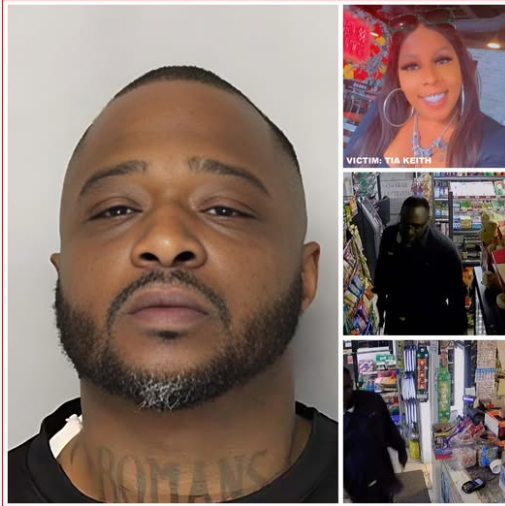
OAKWOOD, GA – The fluorescent lights of the Quick Mart on Thompson Bridge Road still flicker with the ghost of a nightmare, their hum now a grim soundtrack to one of the most brazen and brutal murders Hall County has witnessed in recent memory. What began as a routine 9:30 p.m. stop for a 44-year-old mother and business owner on Thursday, July 16, devolved into a scene of cinematic horror that has left law enforcement scrambling, a community in shock, and a cold-blooded killer—Antwane Sintell Thurmond—still at large as of this writing.
The victim, Tia Vidon Keith, a well-regarded Oakwood resident known for her warm smile and unyielding work ethic, had pulled her silver Hyundai Tucson into the parking lot of the convenience store, intending only to grab a quick beverage and a snack before heading home to her two teenage children. She had no way of knowing that her former live-in boyfriend, a 45-year-old disabled Army veteran with a history of volatile behavior and a deeply troubled romantic history with Keith, was already lurking in the shadows, waiting for the precise moment to turn her sanctuary into a slaughterhouse.
According to a harrowing timeline pieced together by Hall County Sheriff’s Office investigators and corroborated by partial surveillance footage obtained by The Atlanta Journal-Constitution, Keith exited her vehicle at approximately 9:27 p.m., leaving her doors unlocked—a habit born of small-town trust that would prove fatal. She walked briskly into the store, greeting the night clerk, a 22-year-old part-time college student named Marcus Delaney, who would later describe her as “cheerful and completely at ease.” As she perused the snack aisle, Thurmond, who had been parked in a black 2014 Ford F-150 three spaces away, maneuvered himself with practiced silence toward Keith’s SUV.
This is where the first layer of mystery deepens. It remains unknown—and is now a central focal point of the investigation—how Thurmond, a man who relies on a prosthetic left leg and walks with a pronounced limp, managed to enter Keith’s vehicle without drawing attention from the store’s exterior cameras or the two other customers present at the time. Deputies theorize that he may have used a spare key, which Keith had not retrieved from him after their split six months prior, or that he employed a lock-picking tool. However, a more chilling possibility has emerged: that Thurmond simply waited, crouched low in the backseat, having entered the vehicle before Keith arrived, lying in ambush for nearly fifteen minutes. The vehicle’s interior did not show signs of forced entry, suggesting the former boyfriend had gained access through means that suggest premeditation of the highest order.
At 9:31 p.m., Keith exited the store, a plastic bag dangling from her left hand. She approached the driver’s side door, unlocked it, and slid into the seat. The moment her weight settled into the driver’s cushion, Thurmond—who had been waiting in the passenger seat, concealed by the dim interior lighting and the angle of the parking lot—sat upright. Witnesses from outside the store reported hearing a muffled pop, followed by three rapid-fire gunshots. The weapon, later identified as a Taurus G2C 9mm semi-automatic pistol, had been pressed directly against Keith’s right ribcage. The first round perforated her lung; the second shattered her clavicle; the third grazed her carotid artery, spraying blood across the windshield in a sickening arc.
In an act of sheer survival instinct that defies medical odds, Keith did not succumb to the initial barrage. Instead, she threw open her driver’s door, tumbling sideways onto the asphalt as the bag of snacks scattered beneath her. She screamed for help, a primal, guttural cry that pierced the night air, and scrambled on all fours toward the store’s glass entrance. Thurmond, with a terrifying calmness, exited the passenger side, limped around the hood of the SUV—his prosthetic leg clicking rhythmically against the pavement—and began a methodical pursuit. He did not run; he walked, closing the distance with a predator’s patience.
Keith reached the store’s automatic doors and shoved them open. She dragged herself across the polished tile floor, leaving a crimson smear that store employees would later describe as “indescribable” and “like a giant red paintbrush.” Marcus Delaney, the young clerk, had just enough time to drop behind the counter, his hands trembling as he dialed 911. He watched in frozen terror as Thurmond crossed the threshold, raised the pistol with a steady, practiced grip, and fired two more rounds into Keith’s back as she clawed futilely toward the slushie machine. The final bullet entered her spine at the T6 vertebra, severing her spinal cord instantly. She collapsed face-first, her body convulsing for a brief, agonizing moment before all motion ceased.
Delaney, whose 911 call lasts six minutes and four seconds—and which authorities have released in heavily redacted form—can be heard sobbing as he whispered, “He shot her again. She’s not moving. He’s walking away. Oh my God, he’s walking away.”
Thurmond exited the store at 9:33 p.m., not in a panicked sprint, but in a leisurely gait, as though he had just completed a mundane chore. He returned to his Ford F-150, placed the handgun on the passenger seat, and drove north on Thompson Bridge Road toward the I-985 interchange. Deputies arrived three minutes later, at 9:36 p.m., to find Keith’s body sprawled in a pool of her own blood, her eyes still open, fixed on the ceiling’s fluorescent tubes. The store’s security cameras captured every angle of the attack, but they also yielded a haunting, unanswered question: How did Thurmond, with his physical disabilities and conspicuous gait, manage to evade detection by the store’s exterior motion sensors or by the two other patrons—a truck driver named Royce Gable and a nurse named Patricia Harlow—who were both inside at the time? Both witnesses told investigators they saw “a man with a limp” near the SUV but assumed he was an employee helping Keith with a flat tire.
The Victim: A Life Cut Short, A Legacy of Resilience
To understand the magnitude of this atrocity, one must first understand Tia Vidon Keith. She was not merely a victim of a domestic violence escalation; she was a pillar of Oakwood’s tight-knit community. Born in Gainesville in 1982, Keith had worked her way up from a receptionist at a local dental clinic to the owner of a small but thriving house-cleaning service, “Tia’s Sparkle Sweeps,” which employed six women, many of them single mothers. She was known for her unorthodox business philosophy—she would often discount her services for elderly clients and would refuse payment from families with children battling cancer.
Her neighbor, 58-year-old Linda Faye Morrison, who lives two doors down from Keith’s modest ranch-style home, described her as “the kind of woman who would bring you a casserole when your cat died, and then stay to help you clean out the basement.” Keith was an active member of the Oakwood Baptist Church, where she led the Wednesday night children’s choir. Her pastor, Reverend Ethan Coyle, told this reporter through tearful eyes that “Tia’s voice could calm a storm. She was singing ‘Amazing Grace’ just last Sunday, and the entire congregation wept because it felt like she was singing directly to God.”
But Keith’s life was not without its scars. She had separated from Thurmond in late January of this year after a tumultuous three-year cohabitation that, according to court filings, was punctuated by two police interventions. In February 2025, Keith filed a temporary protective order against Thurmond, alleging that he had grabbed her by the throat during an argument over his gambling habits. The order was dismissed a month later when Keith failed to appear for the hearing—a move that her friends now say she regretted deeply. “She was terrified of him,” said her best friend, Sharice Monroe. “He would tell her that his military training made him ‘unbreakable,’ and that if she ever tried to leave, he would ‘find her in any state, any country.’ She didn’t take that as a threat; she took it as a promise.”
Indeed, Thurmond’s background painted a portrait of a man teetering on the edge of instability. A former combat engineer who served two tours in Afghanistan with the 3rd Infantry Division, he lost his lower left leg in 2012 after an IED detonation near Kandahar. While his physical injuries were severe, his psychological wounds proved far more insidious. Medical records obtained from the VA show that he was diagnosed with PTSD, major depressive disorder, and a specific pattern of intermittent explosive disorder. He was prescribed a cocktail of medications—including sertraline and quetiapine—but he routinely skipped his appointments, stating to his caseworker that “pills make me feel like a zombie.”
Thurmond’s criminal history was sparse but alarming. In 2017, he was arrested for felony aggravated assault after beating a neighbor with a metal crutch during a dispute over a parking space; the charges were dropped when the neighbor refused to testify. In 2019, he was accused of stalking a former girlfriend in Forsyth County, but again, the case disintegrated due to lack of evidence. His relationship with Keith, however, was the most volatile. Several of Keith’s friends recall seeing bruises on her forearms in late 2024, which she excused as “lifting furniture.” In hindsight, they were the unmistakable marks of a man’s grip.
The Suspect: An Army of One, Now a Fugitive on Two Limbs
As of today, Antwane Sintell Thurmond remains the subject of a multi-jurisdictional manhunt that has expanded into four Georgia counties: Hall, Forsyth, Gwinnett, and Jackson. The Hall County Sheriff’s Office, in collaboration with the Georgia Bureau of Investigation and the U.S. Marshals Service, has deployed helicopter units, K-9 teams, and over 40 officers on the ground. Yet, despite an intensive dragnet, Thurmond has vanished like a ghost. His Ford F-150 was found abandoned at 11:47 p.m. on Thursday night—two hours after the murder—in a wooded area off Highway 53 near the town of Braselton. The vehicle was locked, the keys still in the ignition, and the Taurus G2C handgun—now confirmed as the murder weapon—was found wiped clean of fingerprints on the driver’s floorboard. Inside the truck, deputies found a duffel bag containing a change of clothes, $800 in cash, and a receipt for a 10:00 a.m. bus ticket to Atlanta, which was never used. This suggests a deliberate misdirection, or perhaps a change of plan driven by panic.
What authorities are most keen to publicize, however, are Thurmond’s distinctive physical markers—and they are impossible to miss. First, his prosthetic left leg is a state-of-the-art Össur Flex-Foot, which he wears with a black calf sleeve. Because of the socket design, his gait is uneven—a distinct “step-drag” rhythm that surveillance footage from a gas station two miles from the crime scene caught as he was making his escape. Second, and most infamously, Thurmond bears a large, meticulously inked tattoo on the right side of his neck, spanning from his jawline to his collarbone. It is a direct quote from the King James Version of the Bible: “Vengeance is mine; I will repay, saith the Lord” —Romans 12:19. The irony is not lost on investigators; the verse, meant to counsel against personal retribution, is now emblazoned on the throat of a man who delivered his own bloody judgment.
“He is walking, he is armed, and he is dangerous,” said Sheriff Jerry Cline in a press conference Friday morning, his voice strained but resolute. “We have reason to believe he has contacts in the Atlanta metropolitan area, including a sister in College Park and an estranged brother in Macon. But we are warning everyone—do not approach him. He is a trained combat veteran, and he has already demonstrated that he will not hesitate to use lethal force. If you see a man matching this description, with a limp, a prosthetic, and a Bible verse on his neck, call 911 immediately. Do not engage.”
The Unanswered Questions: How, Why, and What Was Overlooked?
The investigation is now pivoting to the most confounding aspect of this tragedy: the premeditated invasion of Keith’s vehicle. Forensics teams have examined the Hyundai Tucson with microscopic precision. No broken locks. No shattered windows. No signs of a struggle inside the vehicle prior to the shooting, save for Keith’s own blood pooling in the driver’s seat. The question haunts the case: Did Thurmond have a spare key? Keith’s family stated that she had changed all the locks on her home and her vehicle’s key fob after their separation, but they cannot definitively confirm whether she retrieved every single key. What if Thurmond, during a period of reconciliation—which occurred briefly in March—had secretly copied the key fob’s signal? What if he had been camping out in the backseat of her car for hours, waiting for the right moment?
The store’s parking lot cameras, while high-definition, do not cover the entire perimeter. The rear of the SUV, where Thurmond may have entered, sits in a blind spot obscured by a concrete utility pole. This means that for the 12 minutes Keith was inside the store, Thurmond could have easily slipped into the back seat through a rear door, his prosthetic leg folded carefully to avoid bumping the seat. He would have been invisible to the clerk, invisible to the truck driver, and invisible to the nurse—until he sat up.
Equally troubling is the question of motive. Keith’s friends and family insist that she had moved on. She had begun dating a man named Derek Hollis, a 40-year-old landscaper, just two weeks ago, and she had told Sharice Monroe that she “finally felt safe again.” She had also taken steps to legally formalize her separation from Thurmond, filing a petition for a permanent restraining order on July 1—just 15 days before her murder. The hearing was scheduled for August 5. Thurmond, who was served with the petition on July 7, did not contest it, but he did leave a voicemail on Keith’s phone that day—a message that investigators have now recovered. In a gravelly, eerily calm tone, he said, “Tia, you’re making a big mistake. Courts don’t protect you. I do. But I’m tired of protecting you. You know what happens when I get tired.”
That voicemail, which lasted 34 seconds, is now being analyzed by forensic linguists. It is the prosecution’s strongest evidence of premeditated intent, should Thurmond be caught. But as of Friday afternoon, he has not been caught. Instead, his cell phone—a Samsung Galaxy S22—was found in a ditch off I-85 near exit 109, smashed into a dozen pieces. He appears to have destroyed any digital trail, and he has not used his credit cards or banking accounts since 9:45 p.m. Thursday. He is effectively off the grid.
The Aftermath: A Community Grieves, A System Questioned
The ripples of this murder have extended far beyond the convenience store’s bloodstained floor. Oakwood has declared a state of mourning; flags at City Hall have been lowered to half-staff. A candlelight vigil is scheduled for Saturday evening at the Oakwood City Park, and thousands are expected to attend. Tia’s two children—a 16-year-old daughter, Kiana, and a 13-year-old son, Jordan—are now in the temporary custody of their grandmother, Alice Keith, who is 72 and has been hospitalized for shock and a mild heart attack.
The tragedy has also ignited a fierce debate about domestic violence protections in Georgia. State Representative Becky Fahy, who represents Hall County, has called for an emergency legislative hearing to examine why Keith’s protective order was not expedited, and why Thurmond was not placed under electronic monitoring given his history. “This is a systemic failure,” Fahy said at a rally outside the courthouse. “Tia Keith did everything right. She filed the papers. She told the police. She changed her locks. But she was still murdered because our system treats restraining orders like pieces of paper, not like life-saving measures.”
The Hall County Sheriff’s Office, for its part, has defended its response. They confirmed that Thurmond had not violated any active warrants at the time of the murder; his 2019 stalking charge was dismissed, and he had no pending detainers. He was, in the eyes of the law, a free man—a free man with a prosthetic leg, a Bible verse, and a bloodlust that he unleashed with terrifying efficiency.
The Manhunt: Race Against Time in the Georgia Heat
As the sun sets on another sweltering Georgia day, the manhunt intensifies. The FBI has been called in to assist, particularly with tracing any potential out-of-state movement. Thurmond’s sister, 47-year-old Debra Thurmond-Wright, has been interviewed twice and has pleaded with him publicly to surrender. In a tearful Facebook Live video, she said, “Antwane, you are not a monster. You are a broken man. But you cannot run. Tia’s blood is on your hands, and your own soul will never be clean. Turn yourself in, brother. Please, before you hurt someone else.”
But so far, silence. The heat map of pings from his destroyed phone suggests he moved erratically after the crime—heading north, then doubling back south, then west—as if intentionally trying to confuse tracking. The last known sighting was at 11:15 p.m. Thursday, when a pilot for a private aviation company spotted a man matching his description limping along a dirt road near the Chattahoochee River, about three miles from the abandoned truck. The pilot called 911, but deputies arrived 18 minutes later to find only a muddy footprint—the left imprint of a prosthetic foot—pressed into the wet earth.
Investigators are now focusing on river access points, believing Thurmond may have waded into the water to obscure his scent from the dogs. They are also monitoring hospitals and urgent care centers, as his prosthetic socket can cause severe chafing if he walks long distances without proper rest, and he may need medical supplies. Yet, he has not been seen—not at a pharmacy, not at a gas station, not at a fast-food drive-through. He has gone to ground in a state that knows no forgiveness for a man who shoots a woman in the back while she crawls for her life.
Conclusion: A Killer’s Tattoo, A Victim’s Legacy
The Bible verse tattooed on Antwane Sintell Thurmond’s neck is now a morbid hallmark—a grotesque signature that will haunt every surveillance camera he passes. But while the ink on his skin speaks of divine vengeance, the real testament lies in the blood of Tia Vidon Keith—a woman who sang hymns and cleaned homes and loved her children with a ferocity that even a coward’s bullet could not erase. As her family prepares to lay her to rest on Tuesday, they have requested that the casket be open, so that mourners can see her face one last time—not to remember the violence, but to remember her smile.
And as the manhunt grinds into its second day, one thing remains certain: Whether Thurmond is caught tonight or in a year, justice will be served. But for Kiana and Jordan Keith, justice will never bring their mother back. It will never erase the image of her collapsed on a store floor, her last breath drawn amid the smell of stale coffee and cheap candy. It will never answer the question they whisper to themselves at night: Why did he hate her so much?
We may never know the full answer. But we do know that Antwane Thurmond—limping, armed, and tattooed with the words of scripture—is out there, watching, waiting. And the entire state of Georgia is waiting for him to make a mistake. When he does, the vengeance he so proudly worships on his neck may be the very thing that brings him to his knees.

Leave a Reply