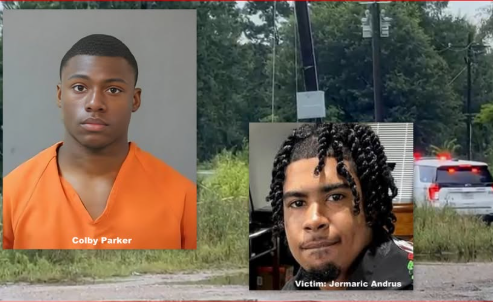
LAKE CHARLES, LOUISIANA — What began as a standard missing persons investigation in Calcasieu Parish has culminated in a highly unusual and deeply unsettling arrest. Colby Ryan Parker, a 28-year-old resident of Lake Charles, walked directly into a local police station to report a vehicle stolen. However, instead of leaving the building as a cooperative complainant, he was led away in handcuffs.
Detectives immediately recognized the vehicle in question as a critical piece of evidence in the active homicide investigation of 27-year-old Jermaric Terez Andrus. This bizarre turn of events has sent shockwaves through the Southwest Louisiana community, raising profound questions about the suspect’s motives and the final days of the victim.
The Disappearance of Jermaric Andrus: A Family’s Nightmare
The tragic chain of events began on July 7, 2026, when the family of 27-year-old Jermaric Andrus officially reported him missing to the Lake Charles Police Department. Andrus, described by those who knew him as a vibrant young man with deep ties to the community, had abruptly ceased all contact with his loved ones. For families of missing adults, the initial hours of a disappearance are characterized by a agonizing mix of panic, confusion, and desperate hope.
Standard law enforcement protocols for missing adults require establishing a baseline timeline:
-
Identifying the last known physical location of the individual.
-
Analyzing recent digital footprints, including cellular pings and social media activity.
-
Interviews with close associates, friends, and coworkers to detect any unusual behavior or recent conflicts.
-
Securing descriptions of any vehicles associated with the individual.
As the days crawled by with no word from Andrus, the worst fears of his family began to crystallize. Detectives working the case realized that his sudden silence was highly uncharacteristic, prompting them to escalate the missing persons file to a potential criminal investigation. Part of this escalation involved flagging a specific vehicle associated with the case—the very vehicle that would later serve as the catalyst for the suspect’s arrest.
The Grim Discovery: A Wooded Grave Near Highway 3059
On the evening of Sunday, July 12, 2026, the trajectory of the investigation shifted from a search-and-rescue operation to a recovery and homicide inquiry. Acting on undisclosed leads and investigative data, Lake Charles Police Department detectives, assisted by the Calcasieu Parish Sheriff’s Office, converged on a remote, heavily wooded area near the intersection of Louisiana Highway 3059 and Luke Powers Road.
At approximately 9:35 p.m., search teams made a devastating discovery: the body of an adult male concealed in the dense underbrush.
Processing the Scene
Forensic investigators and crime scene technicians immediately cordoned off the rural area, establishing a secure perimeter to preserve fragile physical evidence. Processing a crime scene in a wooded, outdoor environment poses significant challenges for forensic teams. Exposure to summer heat, humidity, and local wildlife can rapidly degrade biological evidence.
Technicians spent hours meticulously documenting the area, searching for:
-
Footprints or tire tracks in the soil surrounding the site.
-
DNA, hair, or fiber transfers on the victim’s clothing.
-
Signs of a struggle or secondary crime scene indicators.
-
The presence of tools or chemicals used to conceal or dispose of the body.
Following a preliminary examination at the scene, the Calcasieu Parish Coroner’s Office took custody of the remains. The body was formally identified as Jermaric Terez Andrus. Investigators swiftly determined that the nature of his injuries pointed directly to homicide, though the specific cause of death has been withheld by authorities to protect the integrity of the active investigation.
The Audacious Police Station Walk-In
With Andrus’s body recovered and his death officially ruled a homicide, detectives intensifed their search for Colby Ryan Parker. Parker, 28, had already been identified by investigators as a key person of interest in Andrus’s disappearance. Authorities were actively preparing to locate and question him when Parker made a move that astonished seasoned law enforcement officers.
On Monday, July 13, 2026, Parker walked through the front doors of the Lake Charles Police Department. His stated purpose for visiting the station was to file a formal report regarding a stolen vehicle.
However, the vehicle Parker claimed had been stolen from him was the exact automobile detectives had already flagged as directly linked to the murder of Jermaric Andrus.
“It is highly unusual for a suspect in a major homicide investigation to voluntarily walk into a police department,” noted a law enforcement analyst familiar with the region’s judicial proceedings. “Often, individuals under intense psychological pressure or those attempting to construct an alibi will make erratic decisions, such as pre-emptively reporting a vehicle stolen to distance themselves from a crime scene.”
Instead of processing a standard auto-theft complaint, desk officers quietly alerted the homicide unit. Detectives who had been actively searching for Parker immediately took him back to an interrogation room.
Inside the Interrogation Room: Unraveling the Alibi
Once inside the secure interview facilities of the Lake Charles Police Department, the dynamic of the interaction shifted entirely. Parker went from being a self-proclaimed victim of vehicle theft to the primary suspect in a capital crime.
Homicide detectives are highly trained in cognitive interviewing techniques designed to identify inconsistencies in a subject’s narrative. When confronted with the reality that investigators had already located Andrus’s body near Highway 3059 and Luke Powers Road, and that his “stolen” vehicle was physically and digitally tied to the crime scene, Parker’s constructed narrative began to crumble.
The transition from a missing persons case to a murder charge requires a high burden of proof, but the intersection of physical evidence, vehicle location data, and Parker’s own self-incriminating timeline provided prosecutors with the leverage needed to secure formal charges.
The Charges: Second-Degree Murder, Obstruction, and Unlawful Disposal
Following a lengthy interrogation, Colby Ryan Parker was formally arrested and transported to the Calcasieu Parish Correctional Center. The Calcasieu Parish District Attorney’s Office approved a series of severe charges reflecting the gravity of the crime:
1. Second-Degree Murder
In the state of Louisiana, Second-Degree Murder carries a mandatory sentence of life imprisonment at hard labor without the benefit of parole, probation, or suspension of sentence. To secure a conviction, the state must prove that the defendant had the specific intent to kill or inflict great bodily harm, or that the killing occurred during the commission of certain specified felony crimes.
2. Obstruction of Justice
The obstruction charge stems from the deliberate alteration, destruction, or concealment of physical evidence. Investigators allege that Parker took active, calculated steps to hide the truth of what happened to Jermaric Andrus, which likely included manipulating the crime scene, cleaning the vehicle, or attempting to mislead officers by filing a false stolen vehicle report at the police precinct.
3. Unlawful Disposal of Human Remains
This specific charge addresses the indignity and criminal concealment of the victim’s body. By transporting Andrus’s remains to a remote wooded area near Highway 3059 and leaving them hidden in the brush, the perpetrator sought to delay discovery and disrupt the natural decay process that assists forensic pathologists in determining the time and manner of death.
The Legal Arena: A $1.2 Million Bond and Courtroom Battles Ahead
Following his booking, a state judge reviewed the initial evidence and set Parker’s total bond at a substantial $1.2 million. This high monetary threshold reflects the violent nature of the charges, the severity of the potential life sentence, and the perceived flight risk of the defendant. Under the terms of the bond, Parker must remain in secure custody at the Calcasieu Parish Correctional Center unless a bail bondsman or family member can secure the massive financial collateral required for his release.
Pre-Trial Timeline and Legal Strategies
As the case moves forward, the legal teams for both the prosecution and the defense will begin the extensive process of discovery.
| Phase of Case | Key Objectives | Expected Timeline |
| Discovery | Exchange of forensic reports, cellular data, and interview tapes between prosecution and defense. | Next 3 to 6 months |
| Preliminary Hearings | Defense challenges to the validity of the arrest, the seizure of the vehicle, and the voluntariness of statements. | Mid-to-late 2026 |
| Grand Jury Review | Formal indictment proceedings to solidify the Second-Degree Murder charges. | Within 60 days of arrest |
Defense attorneys will likely scrutinize the circumstances of Parker’s arrival at the police station. They may argue over whether he was formally “in custody” during the initial phases of his questioning and whether his constitutional rights, including his Miranda rights, were fully protected before he made any potentially self-incriminating statements.
Conversely, the prosecution will rely heavily on the physical forensics extracted from the wooded recovery site and the interior of the vehicle, alongside cellular location mapping, to build an airtight narrative of Parker’s movements between July 7 and July 12.
A Community Mourns: Remembering Jermaric Terez Andrus
While the legal machinery begins to turn for Colby Ryan Parker, the family and friends of Jermaric Andrus are left to navigate an unimaginable grief. At just 27 years old, Andrus’s life was cut tragically short, leaving a void in the hearts of those who loved him.
In Southwest Louisiana, a region known for its close-knit neighborhoods and resilient community spirit, the news of Andrus’s violent death has prompted an outpouring of support. Memorials, family vigils, and digital tributes have highlighted a young man who was deeply valued by his peers.
The case serves as a stark reminder of the unpredictable nature of criminal investigations. For the detectives of the Lake Charles Police Department, the swift resolution of the missing persons case—evolving into a homicide arrest in less than 48 hours after the body’s discovery—brings a degree of closure to the active search, but the long road to justice in the courtroom is only just beginning.

Leave a Reply