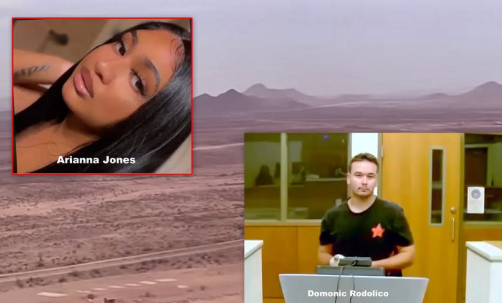
LAKE PLEASANT, ARIZONA — In a chilling case that has shaken the local community and highlighted the hidden dangers of modern digital interactions, 24-year-old Arizona resident Domonic Rodolico has been arrested and charged with the first-degree murder of 21-year-old Arianna Jones. Authorities allege that what was framed as a standard movie date between two young people who met on social media was, in reality, a meticulously premeditated execution.
The tragic sequence of events, unraveling over the early days of July, paints a horrifying picture of deception, leading to a remote, shallow grave in the unforgiving Arizona desert. Through rapid response, rigorous surveillance, and advanced digital forensics, investigators pieced together a timeline that dismantled the suspect’s shifting narratives and brought a grim resolution to a family’s frantic search for their missing daughter.
The Illusion of a Normal Connection: Social Media and the Modern Date
In today’s hyper-connected world, social media platforms have become the primary avenue for young adults to meet, socialize, and arrange dates. For 21-year-old Arianna Jones, an interaction on one of these platforms led to a planned evening out with Domonic Rodolico. The initial digital footprint between the two showed typical conversational patterns—arranging a time, picking a location, and settling on a casual evening at a local movie theater.
However, law enforcement officials warn that the digital veil can easily mask predatory intentions. Unlike meeting through mutual friends or in localized community settings, social media interactions often lack the background checks naturally provided by a shared social circle. In this case, the investigation revealed a stark and terrifying contrast between the casual nature of the digital messages exchanged and the sinister preparations allegedly being made in the physical world.
The Anatomy of Premeditation: July 5th Preparations
The bedrock of a first-degree murder charge in the state of Arizona is the concept of premeditation—the conscious decision to kill, formulated before the act is carried out. The evidence gathered by detectives suggests that the tragedy of Arianna Jones was not a date gone wrong or a crime of sudden passion, but a carefully orchestrated plot.
According to police records, the timeline of the crime began before the two even met for their date. On July 5, data indicates that Rodolico drove out to a desolate and remote section of the desert near Lake Pleasant. Lake Pleasant Regional Park, while a popular recreation area, is surrounded by vast tracts of unforgiving, isolated terrain.
During this preliminary trip, investigators allege that Rodolico was not merely scouting a location, but actively preparing a burial site. He is accused of bringing concrete mix and other supplies to the desolate area, digging a shallow grave, and laying the groundwork for a cover-up before Jones ever stepped into his vehicle. This specific detail—preparing a grave with construction materials days in advance—demonstrates a chilling level of psychological detachment and calculated intent, forming the cornerstone of the prosecution’s capital murder case.
The Date: A Timeline of Deception
Following his alleged preparations in the desert, Rodolico proceeded with the agreed-upon date. He drove to Jones’s apartment complex and picked her up in his Nissan Sentra.
The Movie Theater Rendezvous
The pair traveled to a local movie theater, an environment designed to be public, safe, and entirely unremarkable. To anyone observing them, they were simply another young couple out for the evening. They approached the concession stand, purchased drinks and snacks, and proceeded to watch a film.
Law enforcement’s reliance on closed-circuit television (CCTV) proved vital in establishing the timeline of this phase. Surveillance footage from the theater captured clear images of both Jones and Rodolico. Crucially, as they exited the establishment after the film concluded, the cameras recorded them carrying distinctive white souvenir cups. This minor, seemingly insignificant detail would later become a critical linchpin in the forensic puzzle.
The Drive into the Darkness
Upon leaving the safety of the well-lit, heavily populated theater, the nature of the evening shifted dramatically. Cellphone data—a critical tool in modern criminal investigations—tracked the movement of both individuals’ devices. Instead of returning to Jones’s apartment, the digital breadcrumbs showed Rodolico’s vehicle heading steadily north, away from the urban grid and deep into the rural expanse surrounding Lake Pleasant.
The drive transitioned from paved highways to remote, unlit dirt roads. Investigators determined through cell tower triangulation that both phones arrived at the exact coordinates of the previously prepared desert site.
For approximately 45 to 50 minutes, the two devices registered side-by-side in this isolated location. In the context of a homicide investigation, this window of time represents the critical period during which the crime was committed. Then, a definitive digital event occurred: Arianna Jones’s cellphone suddenly and permanently disconnected from the cellular network, either due to being destroyed, powered down, or having its battery removed.
Roughly 10 minutes after Jones’s digital footprint vanished, the data showed Rodolico’s phone leaving the area. He was traveling alone.
The Investigation Initiates: A Family’s Worst Nightmare
When Arianna Jones failed to return home and ceased all communication, her family grew immediately concerned. By July 7, after two agonizing days of unanswered calls and texts, they officially reported her missing to local authorities.
The early hours of a missing person investigation are notoriously critical. Law enforcement immediately initiated standard protocols: checking local hospitals, interviewing family and friends, and executing emergency subpoenas for cellular and digital records.
Following the Digital Trail
It was the review of Jones’s phone records that provided the first major breakthrough. The logs highlighted her recent, intensive communication with Rodolico, establishing him as the last known person to see her alive. Moving swiftly, detectives shifted their focus from a standard missing person search to a targeted criminal investigation, placing Rodolico under covert surveillance.
The Desperate Cover-Up
While under police observation, Rodolico exhibited classic post-offense behavior aimed at destroying evidence. Detectives watched as he engaged in repeated, frantic efforts to sanitize his Nissan Sentra.
He was observed at a local car wash, paying meticulous attention to the passenger-side rear area, the trunk, and the interior upholstery. He vigorously vacuumed and wiped down surfaces, attempting to erase any physical trace of his passenger. Unaware that law enforcement was documenting his every move, he eventually returned to his residence, where he continued to clean the vehicle.
However, forensic science operates on Locard’s Exchange Principle, which dictates that “every contact leaves a trace.” Despite his extensive efforts to wash away the evidence, investigators knew that microscopic DNA, blood spatter, and fibers are incredibly difficult to eradicate completely, especially from the complex fabrics and crevices of a vehicle interior.
The Gruesome Discovery at Lake Pleasant
While surveillance teams monitored the suspect, a separate forensic team utilized the subpoenaed cellphone location data to retrace the final journey of Arianna Jones. The coordinates led them directly to the remote, unforgiving brush of the Lake Pleasant desert.
Executing a grid search of the terrain where Jones’s phone had last pinged, search and rescue personnel noticed disturbed earth. There, they uncovered a shallow grave containing the young woman’s body.
The Forensic Evidence Recovered
The crime scene was a localized repository of damning physical evidence, directly linking the gravesite to the movie theater and the preparations made on July 5. The meticulous collection by crime scene technicians yielded the following items:
-
The White Souvenir Cups: The exact cups seen in the hands of the victim and suspect on the theater surveillance footage were found discarded at the scene, tying the location directly to the immediate aftermath of the date.
-
Concrete Mix Bags: Confirming the premeditated nature of the site, bags of concrete mix were recovered.
-
Fry’s Plastic Water Bottles and Latex Gloves: Items indicative of the physical labor of digging and the suspect’s attempt to avoid leaving fingerprints or DNA.
-
Personal Items: A bra and a distinct hair accessory, which investigators confirmed matched the one Jones was wearing on the night of the movie date.
-
Condom Wrapper: Pieces of a torn condom wrapper were located near the gravesite, raising grim questions about the nature of the assault prior to the murder.
-
The Red Substance and Eyelash Strip: Perhaps most chillingly, one of the heavy concrete bags was found with an eyelash strip attached to it, adhered by what appeared to be a red substance—highly indicative of blood.
The Maricopa County Medical Examiner’s Office was tasked with taking custody of the victim’s remains to perform a comprehensive autopsy. While police have maintained strict operational security and have not yet publicly disclosed the specific cause or mechanism of Jones’s death pending final pathological reports, the physical evidence at the scene points to a violently fatal encounter.
The Interrogation: Shifting Narratives and Fabricated Alibis
Following the discovery of the body and the overwhelming compilation of digital and physical evidence, authorities moved to formally detain and question Domonic Rodolico. In the interrogation room, detectives utilized the gathered evidence to systematically dismantle the suspect’s defense.
Faced with the reality that police knew he was with Jones on the night of her disappearance, Rodolico initially attempted to cast himself as a fellow victim.
The “Two Unknown Men” Fabrication
Rodolico first claimed that after the movie, he and Jones were parked in his vehicle when two unknown male assailants suddenly attacked them. According to this initial narrative, the phantom men cornered them in the backseat of his Nissan Sentra and viciously stabbed Jones to death while he was helpless to stop them.
Experienced homicide detectives recognize this as a common deflection tactic. The story immediately fell apart under scrutiny. It failed to account for why he never called 911, why he didn’t seek medical attention, why he was seen frantically cleaning his car days later, and crucially, how Jones’s body ended up buried in a pre-dug grave with concrete mix. When confronted with these glaring inconsistencies and the cell tower data proving his solitary departure from the scene, Rodolico admitted to investigators that the story was entirely fabricated.
The “Unknown Mastermind” Defense
Forced to abandon his first lie, Rodolico pivoted to a second, equally implausible narrative. He admitted to bringing Jones out to the remote desert location, but he claimed he was acting under the strict instructions of an “unknown man.”
In this version of events, Rodolico attempted to mitigate his culpability by framing himself as an unwitting courier. He insisted he had no idea that Jones was going to be harmed, let alone murdered. However, when pressed by detectives to provide identifying information about this alleged mastermind—a name, a physical description, a phone number, or the medium through which they communicated—Rodolico was entirely unable to produce a single verifiable detail.
Furthermore, during the course of the interrogation, Rodolico made a critical concession that severely undermined his own defense: he admitted that he had personally visited that exact, isolated desert location prior to picking Jones up for their movie date. This admission neatly tied him to the July 5th preparations and the concrete mix found at the scene, shattering the illusion that he was a surprised, innocent bystander.
Legal Repercussions and First-Degree Murder Charges
Armed with a confession of his presence at the scene, a trail of incontrovertible digital evidence, CCTV footage, and physical forensics recovered from a premeditated gravesite, the Maricopa County Attorney’s Office moved swiftly.
Domonic Rodolico has been formally charged with First-Degree Murder.
In Arizona jurisprudence, a first-degree murder charge requires the state to prove beyond a reasonable doubt that the defendant acted with premeditation—meaning the defendant intended to kill and reflected on that intention before acting. The prosecution will undoubtedly anchor their case on the July 5th desert visit and the advance purchase and staging of burial materials, arguing that Rodolico planned the execution of Arianna Jones days before he ever bought her a movie ticket.
Due to the severity of the charges, the overwhelming nature of the evidence, and the demonstrated flight risk and danger to the community, a judge has ordered Rodolico to be held in custody on a staggering $2 million cash bond.
The Judicial Process Moving Forward
As the case moves from the investigation phase into the judicial system, several critical steps remain:
-
Grand Jury Indictment: The prosecution will likely present their findings to a grand jury to secure a formal indictment.
-
Autopsy and Forensic Results: The final autopsy report will be released to the prosecution, detailing the exact cause of death. Furthermore, the crime lab will return DNA analysis on the red substance, the latex gloves, and the interior of the Nissan Sentra.
-
Discovery Phase: The defense attorneys representing Rodolico will receive all the evidence gathered by the state, including the cell site analysis and interrogation tapes.
-
Pre-Trial Motions: Both sides will argue over what evidence is admissible in court.
Given the brutal and premeditated nature of the allegations, legal analysts suggest this case will be prosecuted with maximum severity, potentially carrying a sentence of life in prison without the possibility of parole, or even capital punishment, should the state choose to seek it under Arizona law.
The Broad Impact: Digital Forensics and Community Safety
The rapid resolution of Arianna Jones’s disappearance is a testament to the evolution of modern policing. Two decades ago, a missing person case in a sprawling metropolitan area surrounded by millions of acres of desert might have taken months or years to solve, potentially devolving into a cold case.
Today, the digital footprints we leave behind—our text messages, our GPS coordinates, the automated pings our phones send to local cell towers, and our transit past private and public security cameras—weave an invisible net that is incredibly difficult for criminals to evade. Investigators utilized these tools flawlessly to construct an inescapable trap of data around the suspect.
However, the technological triumphs of law enforcement offer little solace to the grieving family of Arianna Jones. Her death serves as a devastating, cautionary tale about the inherent risks of modern dating. Advocacy groups and law enforcement agencies continually stress the importance of personal safety protocols when meeting individuals known primarily through digital screens:
-
Always meet and remain in public spaces during early interactions.
-
Share live location data with a trusted friend or family member for the duration of the date.
-
Arrange independent transportation to and from the venue, ensuring you are not reliant on a stranger to get home.
-
Trust your instincts; if a situation or a suggested change in venue (like driving to a remote area) feels uncomfortable, it is vital to extract oneself immediately.
As the community of Lake Pleasant and the greater Arizona area reels from the shocking details of this premeditated crime, the focus shifts to the courthouse. The justice system will now take on the solemn burden of holding Domonic Rodolico accountable for the calculated, senseless theft of a young woman’s life.

Leave a Reply